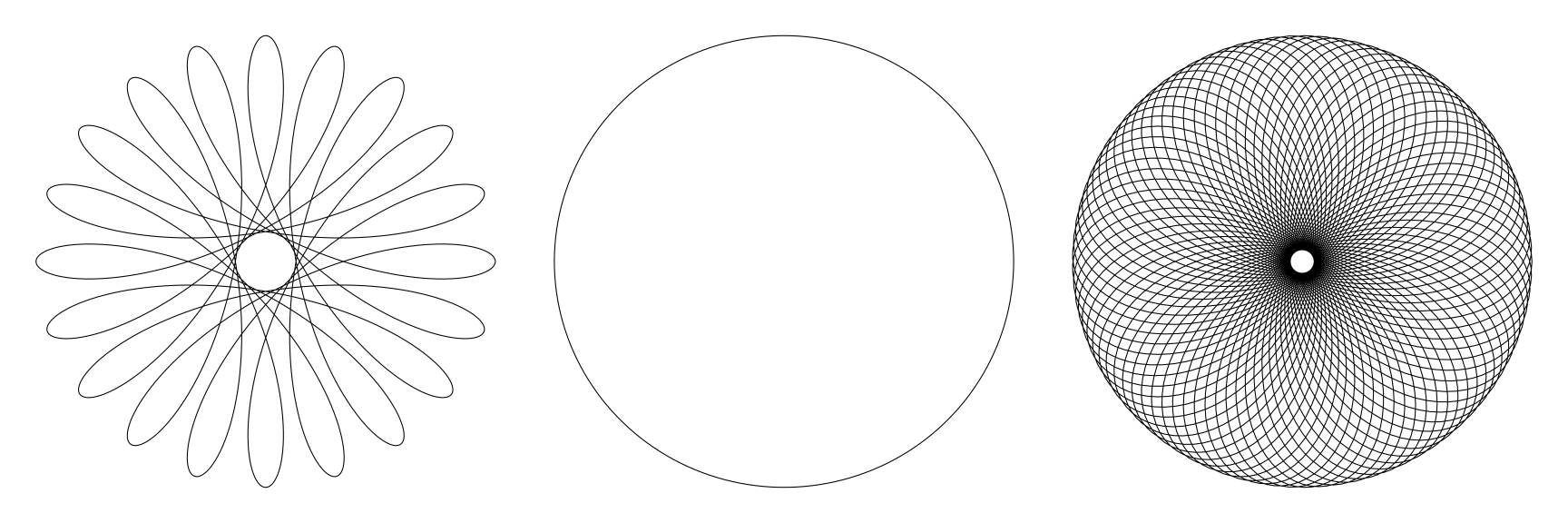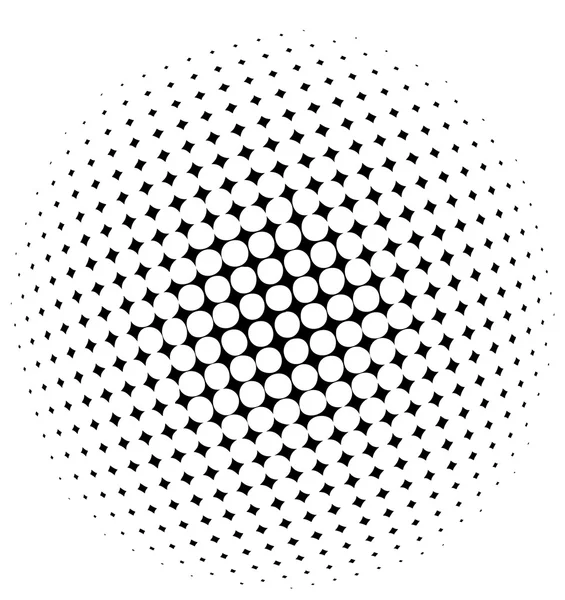
Art derived from mathematics - each piece emerges from precise algorithms, geometric relationships, and the elegant logic of numbers

vertical elliptica logo

All works shown here are created using genuine mathematical algorithms written in Python.

attractors

In the mathematics of dynamical systems, an attractor is a set of values towards which a system naturally evolves over time, effectively acting like a "magnet" for the system's behaviour.
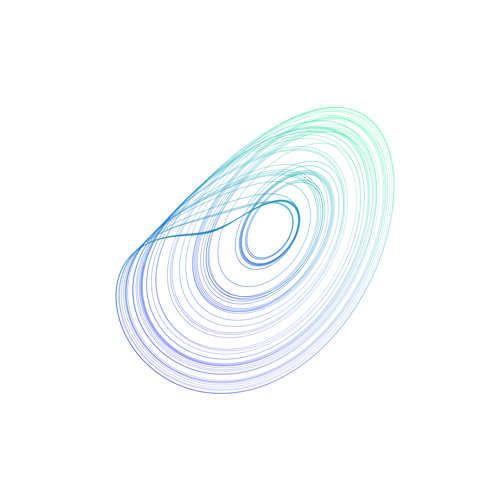
Arneodo Attractor System: Chaos Theory (Continuous ODE)
Name: Arneodo Attractor
Color Map: winter (Mapped to Z-Coordinate)
Coordinate System: 3D Phase Space (x, y, z)
Time Span: 200.0
Points: 50000
Equation: dx/dt=y; dy/dt=z; dz/dt=-alphax - betay - gamma*z + x^2
Parameters: alpha=7.5, beta=3.8, gamma=1.0
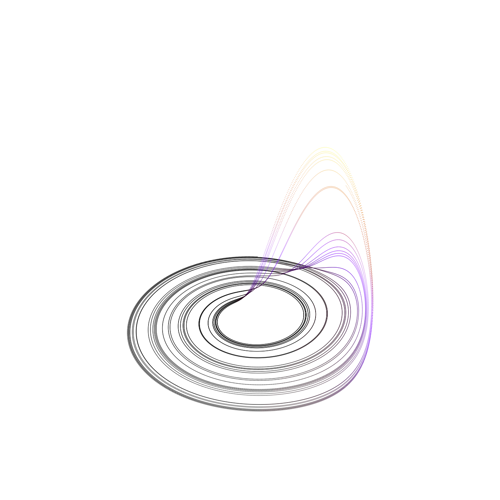
Rössler Attractor System: Chaos Theory (Continuous ODE)
Name: Rössler Attractor
Coordinate System: 3D Phase Space (x, y, z)
Time Span: 200.0
Points: 50000
Equation: dx/dt = -y-z; dy/dt = x+ay; dz/dt = b+z(x-c)
Parameters: a=0.2, b=0.2, c=5.7
Render Style: Scatter (s=0.5) with Transparent Background
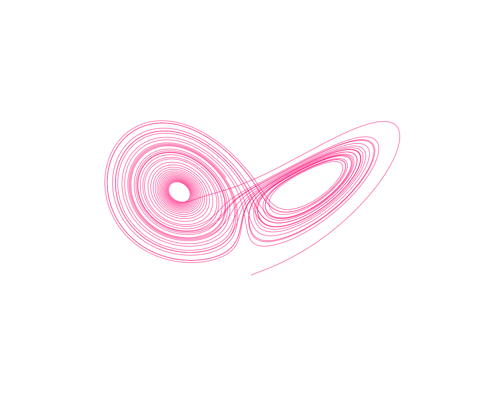
Lorenz Attractor System: Chaos Theory (Continuous ODE)
Name: Lorenz Attractor
Color: #ff006e (Pink)
Parameters: rho={RHO}, sigma={SIGMA}, beta={BETA:.4f}
Time Span: {T_END}
Points: {NUM_POINTS}
Render Style: Line Plot (lw=0.7) with Transparent Background
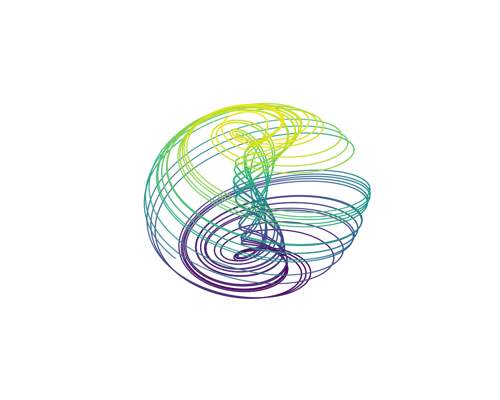
Aizawa Attractor System: Chaos Theory (Continuous ODE)
Name: Aizawa Attractor
Color Map: viridis (Mapped to Z-Height)
Coordinate System: 3D Phase Space (x, y, z)
Time Span: 100
Points: 50000
Equation: dx/dt=(z-b)x-dy; dy/dt=dx+(z-b)y; dz/dt=c+az-z^3/3-(x^2+y^2)(1+ez)+fzx^3
Parameters: a=0.95, b=0.7, c=0.6, d=3.5, e=0.25, f=0.1
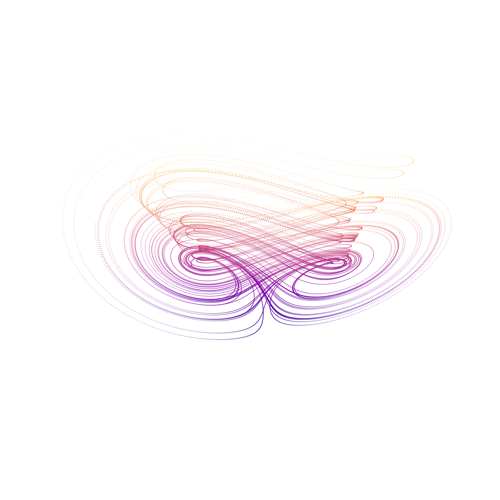
Chen Attractor System: Chaos Theory (Continuous ODE)
Name: Chen Attractor
Color Map: plasma (Mapped to Z-Coordinate)
Coordinate System: 3D Phase Space (x, y, z)
Time Span: 50.0
Points: 50000
Equation: dx/dt=a(y-x); dy/dt=(c-a)x-xz+cy; dz/dt=xy-bz
Parameters: a=35.0, b=3.0, c=28.0
Sprott B System: Chaos Theory (Continuous ODE)
Name: Sprott B Attractor
Color Map: cool (Mapped to Z-Coordinate)
Coordinate System: 3D Phase Space (x, y, z)
Time Span: 200.0
Points: 50000
Equation: dx/dt=ayz; dy/dt=x-z; dz/dt=b-xy
Parameters: a=0.4, b=1.2
Render Style: Scatter (s=0.5) with Transparent Background

parametric

Parametric curves are geometric shapes defined by equations where each coordinate is a function of a single independent variable (often "t"), allowing for the description of complex, self-intersecting paths that standard functions cannot model.
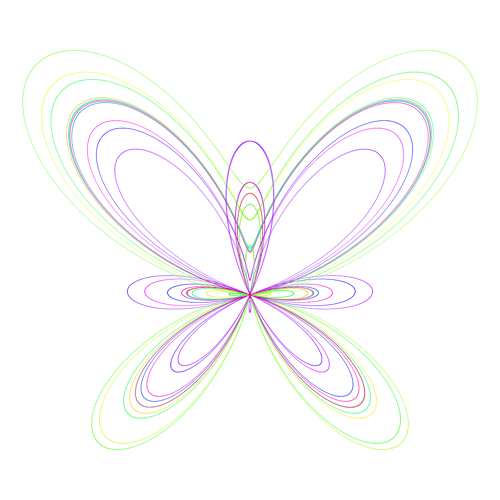
Butterfly Parametric System: 2D Parametric Curve
Name: Temple H. Fay Butterfly Curve
Color Map: hsv (Cyclic, Mapped to Theta)
Coordinate System: Polar to Cartesian
Theta Range: 0 to 24pi
Data Points: 100000
Equation r: exp(sin(theta)) - 2cos(4theta) + sin((2theta - pi)/24)^5
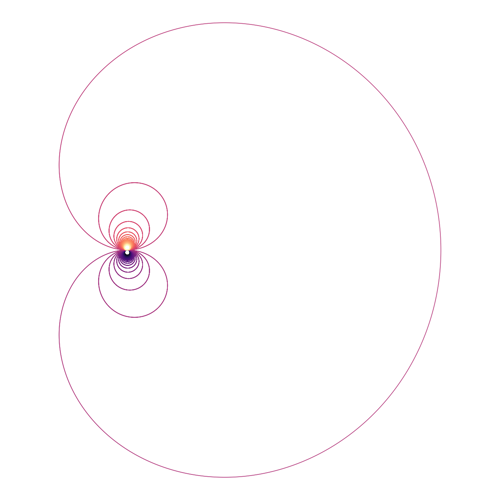
Cochleoid Curve System: 2D Parametric Curve
Name: Cochleoid Curve (Snail Curve)
Color Map: magma (Non-Cyclic, Mapped to Theta)
Coordinate System: Polar to Cartesian
Theta Range: -20pi to 20pi
Data Points: 100000
Equation r: a * sin(theta) / theta
Parameter a: 10.0
Maurer Rose System: Maurer Rose (Parametric)
Name: Crystalline Rose
Coordinate System: 2D Polar -> Cartesian
Domain: k in [0, 360]
Parameter n: 6 (Petal Count/Frequency)
Parameter d: 71 (Angular Step in Degrees)
Equation: theta = k * d
r = sin(n * theta)
x = r * cos(theta)
y = r * sin(theta)
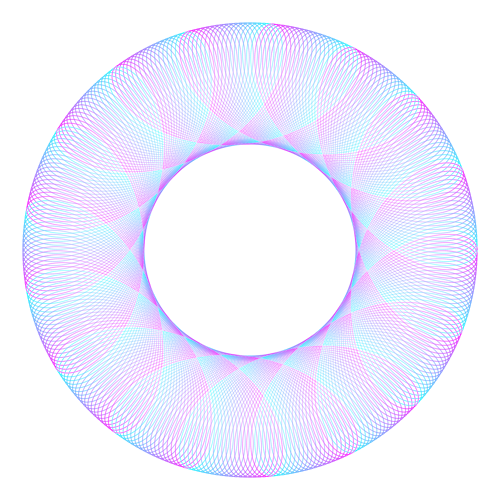
Hypotrochoid System: 2D Parametric Curve
Name: Hypotrochoid (Spirograph)
Coordinate System: Cartesian
Parameter t Range: 0 to 106*pi
Data Points: 100000
Equation x: (R - r) * cos(t) + d * cos((R - r) / r * t)
Equation y: (R - r) * sin(t) - d * sin((R - r) / r * t)
Parameters: R=300.0, r=53.0, d=90.0
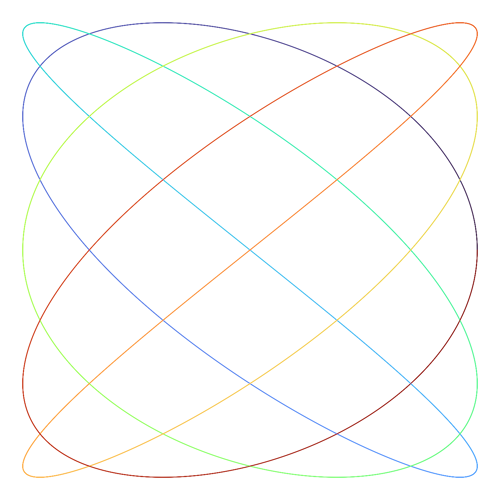
Lissajous Curve System: 2D Parametric Curve
Name: Lissajous Curve (5:4 Ratio)
Color Map: turbo (Cyclic, Mapped to Time Parameter t)
Coordinate System: Cartesian
Parameter t Range: 0 to 2pi
Data Points: 100000
Equation x: A * sin(at + delta)
Equation y: B * sin(b*t)
Parameters: A=10.0, B=10.0, a=5, b=4, delta=pi/2
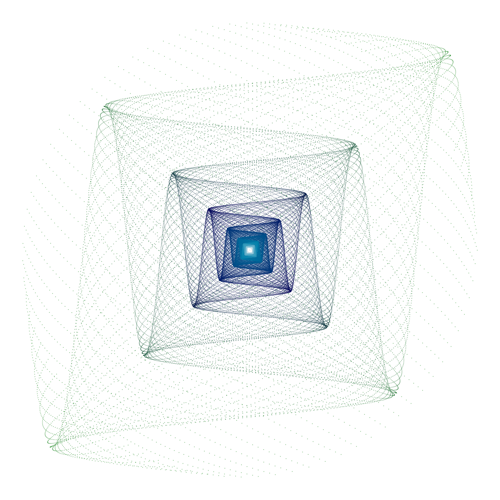
Harmonograph System: Damped Parametric (Harmonograph)
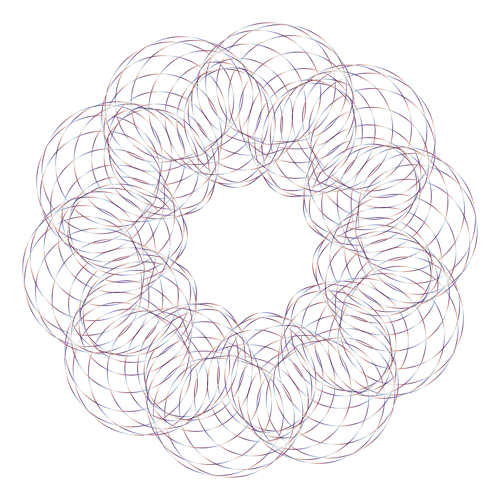
Name: Wireframe Shell / Damped Lissajous
Coordinate System: Cartesian
Parameter t Range: 0 to 800pi
Data Points: 100000
Equation x: A * sin(f1t + delta) * exp(-d1t)
Equation y: B * sin(f2t) * exp(-d2*t)
Parameters: A=10.0, B=10.0, f1=3.0, f2=3.02, d1=0.002, d2=0.002, delta=pi/2
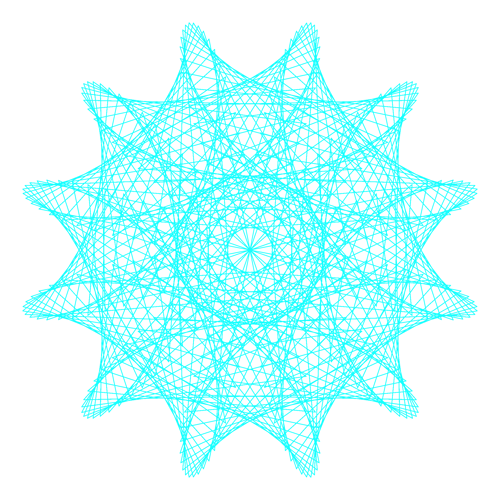
Guilloché Pattern System: 2D Parametric Curve (Guilloché)
Name: Intricate Security Pattern Variation
Coordinate System: Cartesian
Parameter t Range: 0 to 200*pi
Data Points: 100000
Equation: Modulated Hypotrochoid (see code for full formulation)
Parameters: R=50.0, r=0.5, p=20.0, Q=8.0, m=10.0
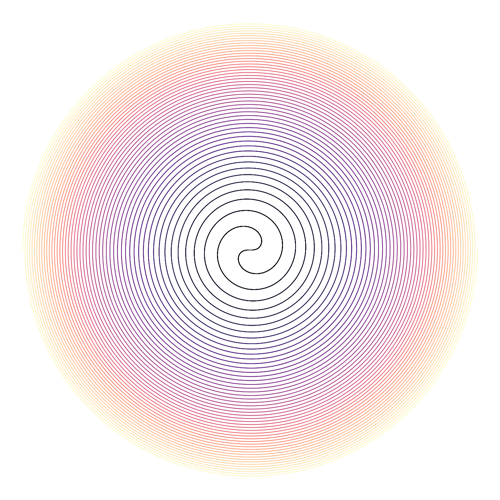
Fermat's Spiral System: 2D Parametric Curve
Name: Fermat's Spiral (Parabolic Spiral)
Color Map: magma (Non-Cyclic, Mapped to Theta)
Theta Range: 0.0 to 50*pi
Data Points: 200000 (Two Arms)
Equation r: c * sqrt(theta)
Parameter c: 2.0

fractals

Fractals are infinitely complex patterns created by repeating a simple equation in a feedback loop, resulting in shapes that look the same at any scale (self-similarity).

Barnsley Fern System: 2D Fractal (Iterated Function System)
Name: Barnsley Fern
Color Map: viridis (Mapped to Y-coordinate)
Coordinate System: Cartesian (Iterative)
Points: 500000
Algorithm: Probabilistic Affine Transformations (4 rules)
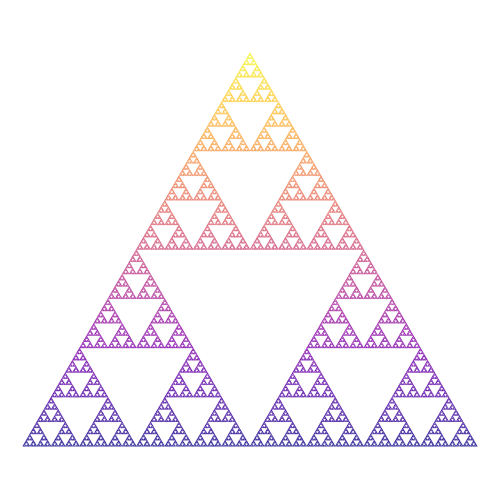
Sierpinski Triangle System: 2D Fractal (Chaos Game)
Name: Sierpinski Triangle (Gasket)
Color Map: plasma (Mapped to Y-coordinate)
Coordinate System: Cartesian (Iterative)
Points: 500000
Algorithm: Chaos Game (3 vertices, 1/2 step)
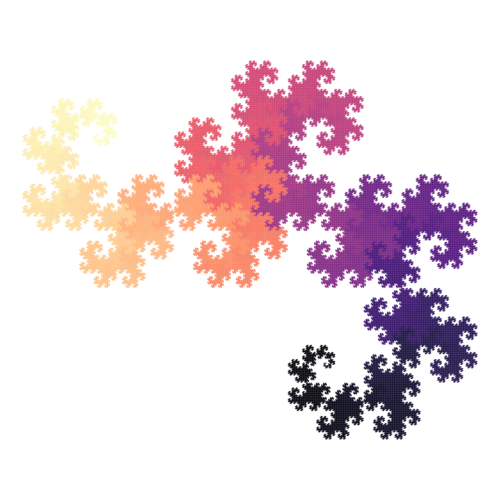
Dragon Curve System: 2D Fractal (Iterated Function System / L-System)
Name: Heighway Dragon Curve
Color Map: magma (Mapped to Path Index)
Coordinate System: Cartesian (Iterative)
Iterations: 18 (Batch Render), 16 (Viewer)
Algorithm: Iterative Folding Sequence
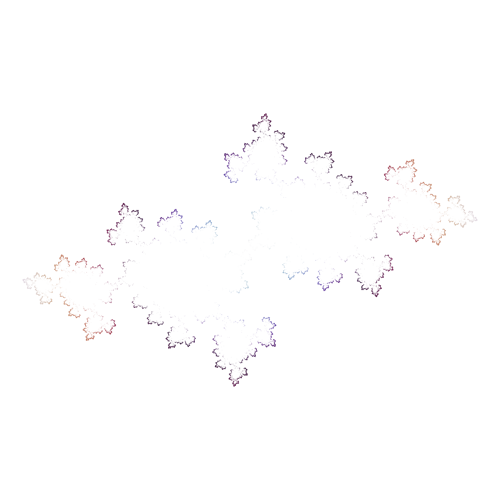
Julia Set System: 2D Fractal (Inverse Iteration Method)
Name: Julia Set Boundary
Color Map: twilight (Mapped to Radial Distance)
Coordinate System: Complex Plane (Cartesian)
Points: 1000000
Equation: z_next = +/- sqrt(z - c)
Parameter c: -0.70176 - 0.3842j
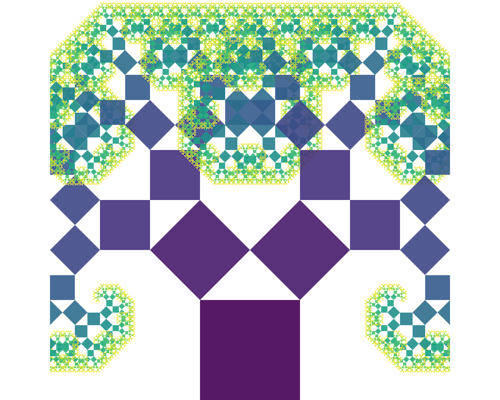
Pythagoras Tree System: 2D Fractal (Geometric Recursion)
Name: Pythagoras Tree
Color Map: viridis (Mapped to Recursion Depth)
Coordinate System: Cartesian
Max Depth: 14 (Batch Render), 12 (Viewer)
Base Square Size: 100.0
Algorithm: Recursive Square Construction (45-45-90 Triangle)
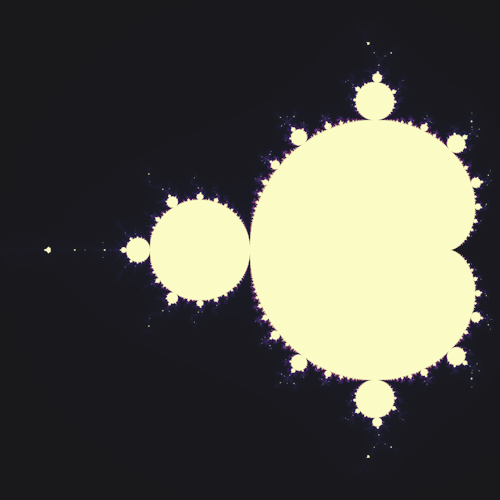
Mandelbrot Set System: 2D Fractal (Complex Dynamics)
Name: Mandelbrot Set
Color Map: magma (Mapped to Escape Time)
Coordinate System: Complex Plane
Domain: x=[-2.0, 0.5], y=[-1.25, 1.25]
Max Iterations: 512 (Batch Render), 256 (Viewer)
Equation: z_{n+1} = z_n^2 + c
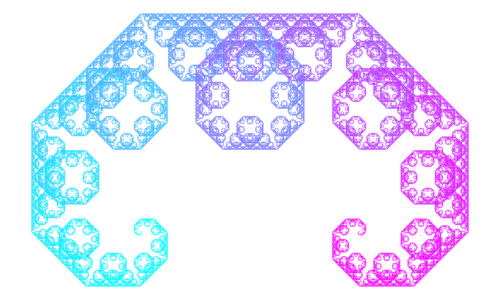
Levy C System: 2D Fractal (Iterated Function System)
Name: Levy C Curve
Color Map: cool (Mapped to Path Index)
Coordinate System: Cartesian (Iterative)
Iterations: 18 (Batch Render), 16 (Viewer)
Algorithm: Iterative Triangle Construction
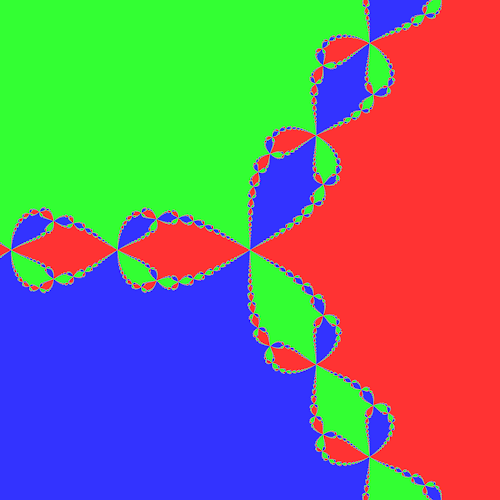
Newton Fractal System: 2D Fractal (Complex Dynamics)
Name: Newton Fractal (Basins of Attraction for z^3 - 1)
Color Map: Custom RGB (Red, Green, Blue for Roots)
Coordinate System: Complex Plane
Domain: x=[-1.5, 1.5], y=[-1.5, 1.5]
Max Iterations: 50 (Batch), 30 (Viewer)
Equation: z_{n+1} = z_n - (z_n^3 - 1) / (3z_n^2)

tessellations

Tessellations are patterns formed by repeating geometric shapes to cover a surface completely without any gaps or overlaps.
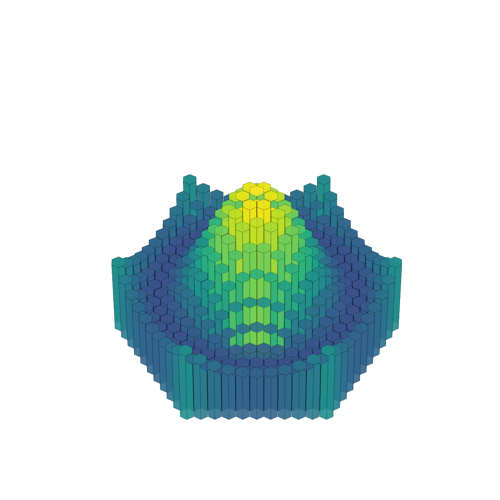
Hexagonal Tessellation System: 3D Tessellation
Name: Hexagonal Honeycomb Wave
Color Map: viridis (Mapped to Height)
Structure: Hexagonal Prisms
Grid Layers: 10
Radius: 1.0
Height Function: 5.0 + 3.0 * cos(distance / 4.0)
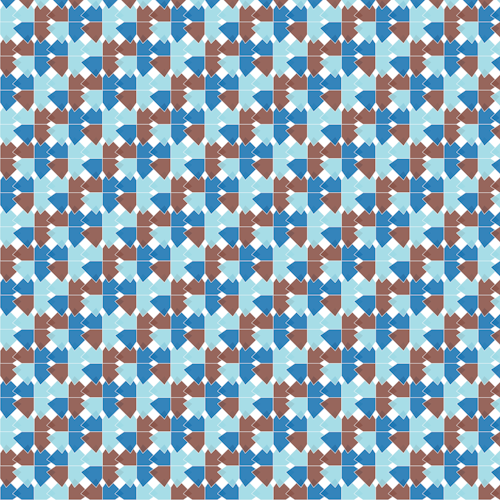
Cairo Pentagonal Tiling System: 2D Tessellation
Name: Cairo Pentagonal Tiling
Color Map: tab20 (Mapped to Tile Grouping)
Structure: Congruent Pentagons (4-fold symmetry groups)
Algorithm: Rotational Cluster Tiling
Render Style: Flat Polygons with Transparent Background
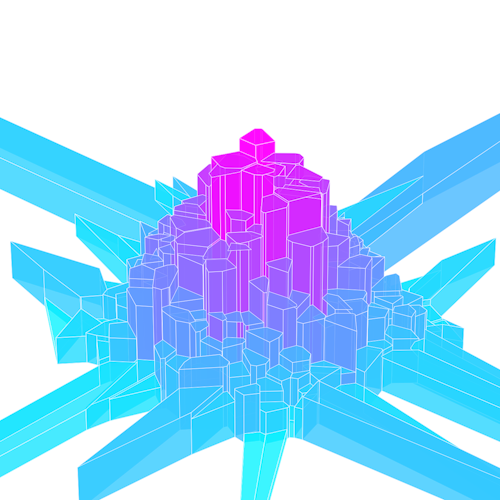
Voronoi Skyscraper Tessellation System: 3D Tessellation
Name: Voronoi Skyscraper City
Color Map: cool (Mapped to Height)
Structure: Random Voronoi Prisms
Seeds: 200 (Batch), 100 (Viewer)
Height Function: Gaussian Distribution (Central Peak)
Render Style: 3D Polygons with Transparent Background
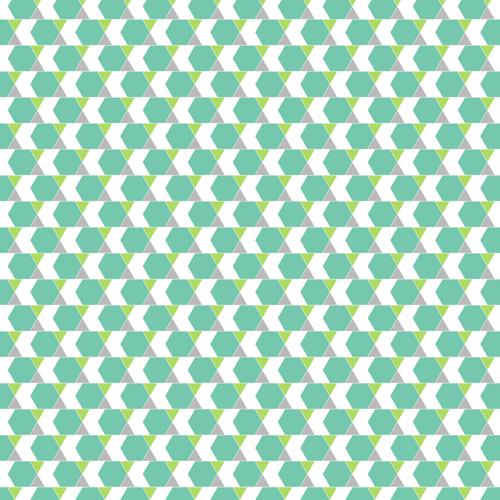
Trihexagonal Tiling System: 2D Tessellation
Name: Trihexagonal Tiling (Kagome Lattice)
Color Map: Set2 (Mapped to Shape Type: Hexagon, Tri-Up, Tri-Down)
Structure: Hexagons and Equilateral Triangles (3.6.3.6)
Algorithm: Grid-Based Unit Cell Placement
Render Style: Flat Polygons with Transparent Background
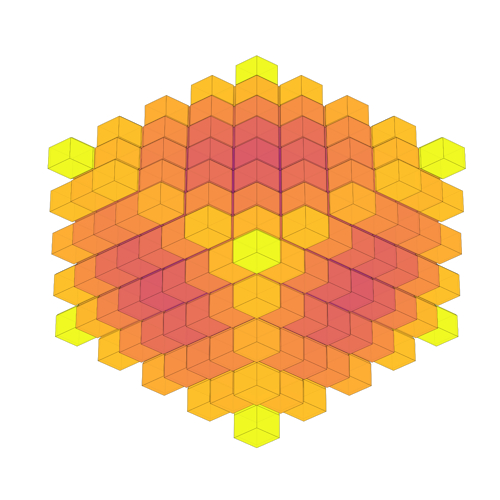
Rhombic Dodecahedron Tessellation System: 3D Tessellation (Space Filling)
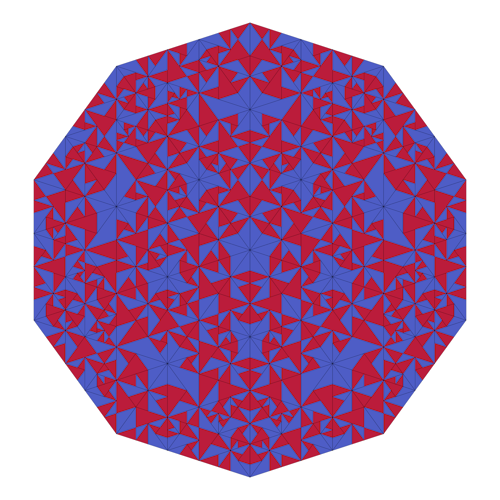
Name: Rhombic Dodecahedron Honeycomb
Color Map: plasma (Mapped to Radial Distance)
Structure: Rhombic Dodecahedra on FCC Lattice
Grid Radius: 4 (Batch), 3 (Viewer)
Render Style: 3D Polygons with Transparent Background
Penrose Tiling System: 2D Tessellation (Aperiodic)
Name: Penrose P3 (Rhombus Tiling)
Color Map: coolwarm (Mapped to Rhomb Type: Thick/Thin)
Structure: Rhombi derived from Robinson Triangles
Generations: 7 (Batch), 5 (Viewer)
Algorithm: Deflation/Substitution

minimal surfaces

A minimal surface is a shape that naturally finds the most efficient way to stretch across a boundary, using the least amount of surface area possible.
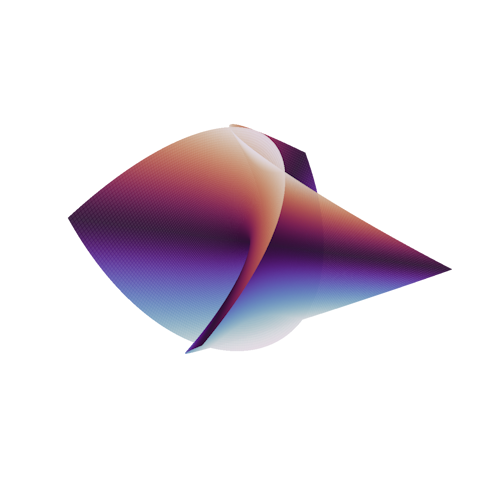
Enneper's Surface System: Minimal Surface (Differential Geometry)

Name: Enneper's Surface
Color Map: twilight (Mapped to Z-Height)
Coordinate System: 3D Parametric Surface
Domain: u,v in [-2.0, 2.0]
Equations: x=u-u^3/3+uv^2; y=v-v^3/3+vu^2; z=u^2-v^2
Render Style: Surface Plot with Transparent Background
Helicoid Minimal Surface System: Minimal Surface (Ruled Surface)
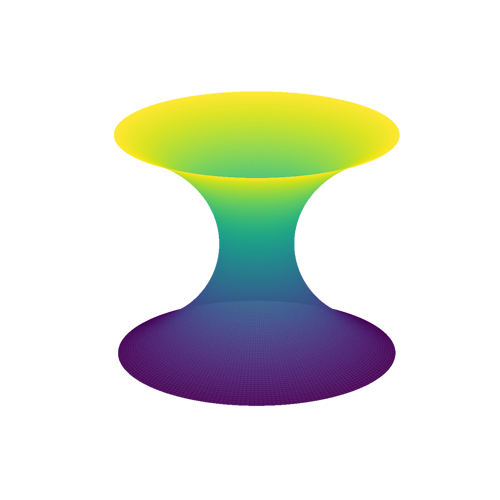
Name: Helicoid
Color Map: plasma (Mapped to Z-Height)
Coordinate System: 3D Parametric Surface
Domain: u in [-2.0, 2.0], v in [-4pi, 4pi]
Equations: x=ucos(v); y=usin(v); z=c*v
Parameter c: 1.0
Catenoid Minimal Surface System: Minimal Surface (Surface of Revolution)
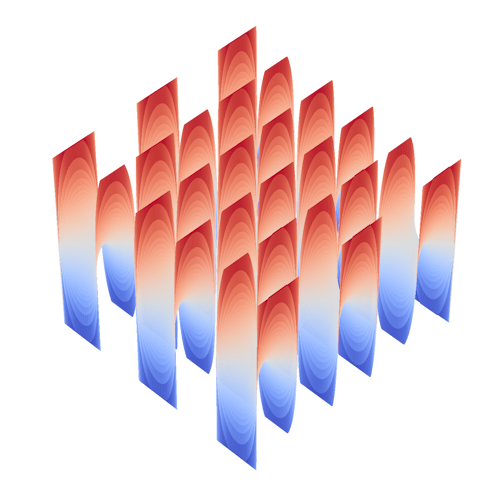
Name: Catenoid
Color Map: viridis (Mapped to Z-Height)
Coordinate System: 3D Parametric Surface
Domain: u in [0, 2pi], v in [-2.0, 2.0]
Equations: x=c*cosh(v/c)cos(u); y=ccosh(v/c)*sin(u); z=v
Parameter c: 1.0
Scherk's Surface System: Minimal Surface (Doubly Periodic)
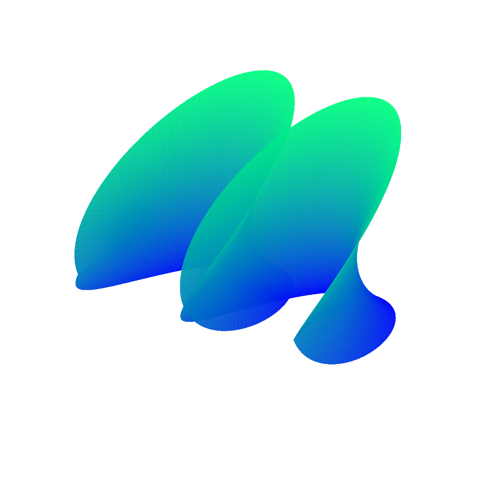
Name: Scherk's First Surface
Color Map: coolwarm (Mapped to Z-Height)
Coordinate System: 3D Surface z(x,y)
Domain: x,y in [-2.5pi, 2.5pi]
Equation: z = ln(cos(x) / cos(y))
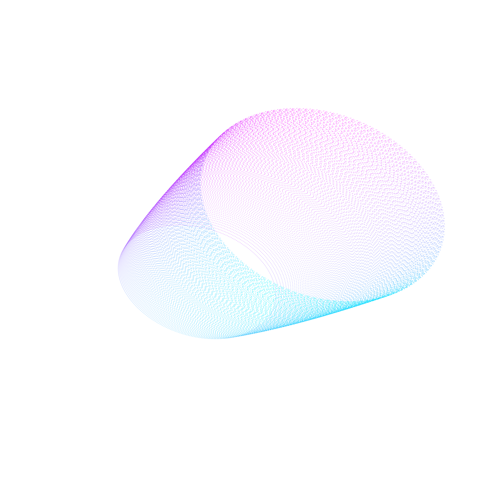
Catalan's Minimal Surface System: Minimal Surface
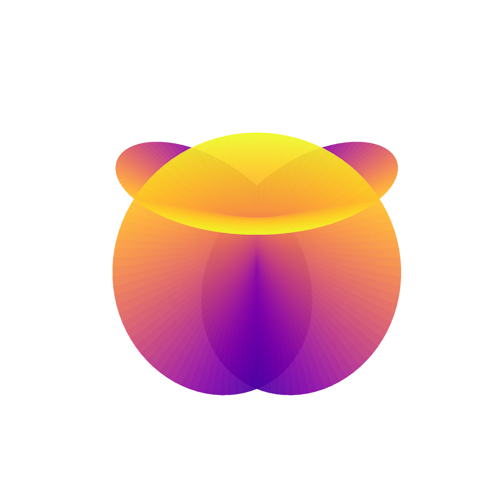
Name: Catalan's Surface
Color Map: winter (Mapped to Z-Height)
Coordinate System: 3D Parametric Surface
Domain: u in [0, 4pi], v in [-1.5, 1.5]
Equations: x=u-sin(u)cosh(v); y=1-cos(u)cosh(v); z=4sin(u/2)sinh(v/2)
Render Style: Surface Plot with Transparent Background
Henneberg's Surface System: Minimal Surface (Non-orientable)
Name: Henneberg's Surface
Coordinate System: 3D Parametric Surface
Domain: u in [0, 0.8], v in [0, 2pi]
Parameters: None (Standard Form)
Equations: x = 2sinh(u)cos(v) - (2/3)sinh(3u)cos(3v)
y = 2sinh(u)sin(v) + (2/3)sinh(3u)sin(3v)
z = 2cosh(2u)cos(2v)

© 2025 elliptica • All rights reserved • Powered by the 3 pillars of web design • HTML, CSS and JS

elliptica